stealthmodels.

MODEL BENCHMARKS

GLM-5.3-Flash

Formerly Ox Alpha, this MIT-licensed multimodal MoE combines a million-token context with low hosted token rates. Read the Ox Alpha reveal and model guide →

BENCHMARK BY BENCHMARK

GLM-5.3-Flash benchmark scores

StealthMark
48.1/100Overall rank 24/58
General Intelligence
41.7/100
Visual Intelligence
59.4/100

GLM-5.3-FlashOther modelsMedian

Reasoning efficiency

How many reasoning tokens a model needs for the quality it delivers.

Single-step reasoningHow much it reasons to understand a taskRank 36/56
Multi-step reasoningHow much it keeps reasoning as a task goes onRank 45/54

Cost efficiency

How much Performance you get for your money.

Rank 16/52

DATASHEET

GLM-5.3-Flash specs and pricing

A good fit forCost-conscious coding and multimodal agents through an API, or self-hosting where several hundred gigabytes of model memory are available.

GLM-5.3-FlashOther modelsMedian

PriceInput / output per 1M tokens
$0.15 / $0.50Cheaper than 39 of 46 others
Context windowTokens in one request
1,000,000Larger than 7 of 49 others
Output speedTokens per second, our measurement
89 tokens/sFaster than 14 of 51 others
Developer
Z.AI
Released
26 Aug 2026
Family
GLM-5
License
MIT
Open model
Yes
Local model
Yes
Parameters
320B
Active parameters
18B
Max output
131,000 tokens
Input → output
Text, image → text
Architecture
Hybrid sparse and linear attention MoE

Run GLM-5.3-Flash locally

Hardware
Multi-GPU workstation/serverEstimated
Download size
200 GB (~4-bit)

Official Hugging Face weightsUnsloth GGUF

All prices and providers2

Vercel AI Gateway / DigitalOcean route; input 0.15 USD/1M; cached read 0.03/1M; output 0.5/1M; A specific gateway provider route; Vercel lists other providers with different prices and limits.

Local deployment details
  • Unsloth UD-Q4_K_XL GGUF200 GB · ~4-bit
Measurements and sources6

GLM-5 family

  1. GLM-5.352.9Compare GLM-5.3-Flash and GLM-5.3
  2. GLM-5.3-Flash48.1This model

GAME BENCHMARKS

Watch GLM-5.3-Flash play

Foresight

Anticipating threats and planning ahead

47.0/100Rank 23/54
Survived 1 of 3
Foresight: complete playing field
Level 316 ptsTurn 20 / 20

Points per level

  1. Level 1Second Thoughts9 ptsBest 27Out of lives
  2. Level 2Pressure Pot6 ptsBest 13Out of lives
  3. Level 3Hide or Flight16 ptsBest 19Survived

Collect coins while avoiding ghosts. Ghosts move before the player each turn, and collisions cost a life. 3 levels in sequence, up to 66 turns in total. Earlier moves and outcomes carry forward, testing learning across levels.

Latch

Cooperative planning and learning from experience

3.6/100Rank 55/55
4 of 5 played
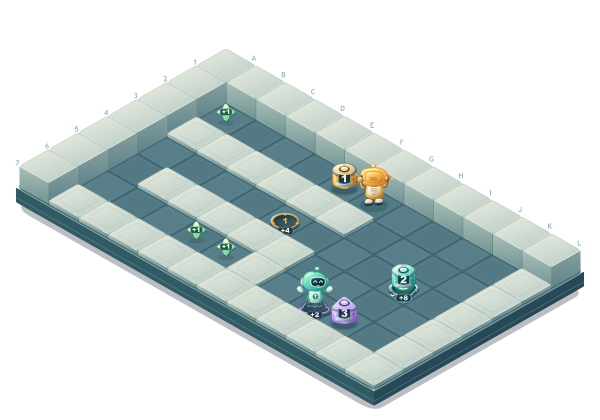
Latch: complete playing field
Level 49.2 ptsTurn 39 / 40

Points per level

  1. Level 1Hold the door4.4 ptsBest 5.2Cleared
  2. Level 2Crossfeed5.2 ptsBest 10.2Finished early
  3. Level 3Relay vault0.6 ptsBest 19.2Finished early
  4. Level 4Passing bay9.2 ptsBest 18.2Finished early
  5. Level 5Second thoughtsNot played

Coordinate two robots to push numbered cores onto matching sockets. Pressure plates hold doors open; moving either robot uses one turn. 5 levels in sequence, up to 152 turns in total. Earlier moves and outcomes carry forward, testing learning across levels.

GLM-5.3-Flash benchmark results ↗

StealthMark score

StealthMark measures how well a model’s abilities carry over to original, demanding tasks it could not have trained for: physical and spatial reasoning, planning across many steps, and precise visual work. How StealthMark works explains every benchmark, what it tests and why it is hard.

General Intelligence

The ability to reason, plan, solve problems and understand how things relate and behave. A high score means it thinks hard problems through, from careful analysis to plans that span many steps.

Visual Intelligence

The ability to understand visual intent and turn ideas, descriptions and plans into coherent, effective visuals. A high score means design ideas come out the way you meant them, in illustrations, icons, diagrams or interface visuals.

Overall score

Overall shows how well a model’s abilities carry over to original, demanding tasks, weighting every benchmark into one score. Estimated means the total includes an estimate for one missing scene.

Judging

Scores reflect how well each result meets the benchmark requirements. Game scores come from the recorded play: the points earned on each level and how each level ended. How StealthMark keeps scores honest.

Games

Each game is a sequence of levels, and earlier moves carry into later levels. A level that was not played is shown as not played and never counts as zero. Play every level of Latch or Foresight yourself to get a score calculated like the models’.

Reasoning efficiency

Good results with little thinking score high. On each task, a model’s result and reasoning tokens are compared with every other model and combined with the Balanced Integration Score (Liesefeld & Janczyk, 2019); 50 is average. Single step shows how much reasoning a model needs to understand and solve one problem, multi-step how efficiently it keeps working on a task by building on its earlier reasoning, as in agentic workflows. Not part of StealthMark.

Cost efficiency

How much StealthMark a model delivers for its money, in StealthMark points per dollar: its overall score divided by what one benchmark task costs it on average. The cost is what our runs were charged, or their tokens at the model’s list price; benchmarks a model has not run yet are estimated from its other costs. Like StealthMark, it is absolute and compares with no other model. Not part of StealthMark.


BENCHMARK RESULTS

Compare results

This link opens the same results in the same order.

StealthMark benchmark results

Reset benchmark preferences?

Return to the default view, clear comparison selections and restore the advertisement.